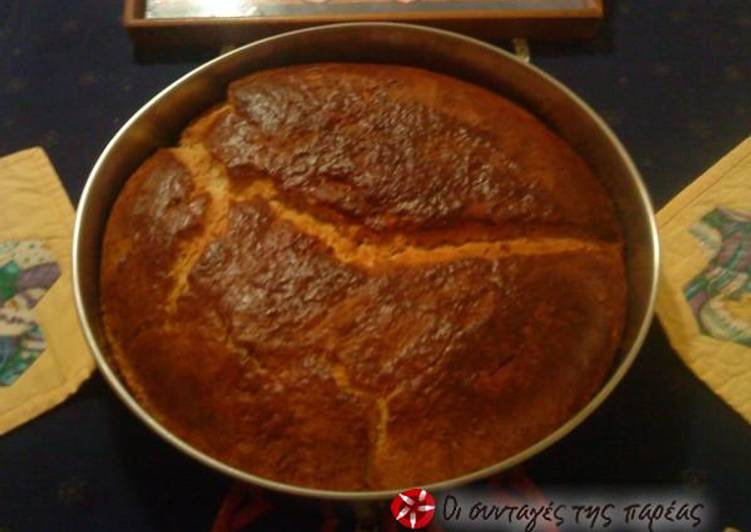
Hey everyone, it’s Brad, welcome to my recipe page. Today, I will show you a way to make a distinctive dish, vasilopita from constantinople. It is one of my favorites food recipes. This time, I am going to make it a little bit tasty. This is gonna smell and look delicious.
See more ideas about Recipies, Vasilopita recipe, Greek pastries. Vasilopita, or Greek New Year's Bread, is a sweet yeasted egg bread scented with orange and traditionally served on New Year's day. Vasilopita is made differently depending in the region. Vasilopita is a Greek New Year's cake with a coin or a trinket baked inside of it.
Vasilopita from Constantinople is one of the most favored of recent trending meals on earth. It’s appreciated by millions daily. It’s easy, it’s quick, it tastes delicious. They are fine and they look wonderful. Vasilopita from Constantinople is something that I’ve loved my entire life.
To get started with this particular recipe, we have to first prepare a few components. You can cook vasilopita from constantinople using 10 ingredients and 24 steps. Here is how you cook it.
The ingredients needed to make Vasilopita from Constantinople:
- Take fresh yeast
- Take cup* milk (lukewarm and not straight from the fridge)
- Make ready sugar
- Make ready all purpose flour
- Get -250 g- melted butter*
- Make ready mahlab (powder)
- Take mastic*
- Make ready eggs (at room temperature)
- Make ready egg yolk (to brush the pie)
- Get bit of white and black sesame (a pinch of each) - optional
Traditional Vasilopita Recipe by Akis Petretzikis. The recipe for Vasilopita differs from region to region across Greece. Mostly it is sweet, whereas in parts of Macedonia the New Years' Cake is salty. This Beautifully Minted Vasilopita Coin with the image of St.
Instructions to make Vasilopita from Constantinople:
- Put the yeast with one cup milk and two handfuls of the flour (which you sift so that your flour is aerated, a property lost when the flour is pressed into its package) into a large bowl. Whisk so that everything incorporates and the smell of the yeast rises. Don't work the mix with your hands because it will stick to them.
- Place your bowl on a chair or on the talbe (or even your bed, why not?) cover with a tea towel (take care so that it is stretched over the edges of the bowl and doesn't touch the mix) and wrap or cover with a blanket (which will provide the warmth necessary for the yeast to rise.
- Leave it to stand for 45 minutes without uncovering your bowl.
- Use a mortar and pestle to grind your mastic (with a bit of sugar) to powder or alternatively use a food processor.
- In about 40 minutes (that is about 5 minutes before you uncover your bowl), melt the butter in a pot at low heat.
- Uncover the bowl (the mixture with the yeast should have risen) and place it on your working surface.
- Add a bit of sifted flour and mix with your hand (the mixture is going to be very sticky so don't put both your hands in the bowl, leave one free so you can add your ingredients).
- Add the egs (whole, without beating them first) and the sugar. Continue kneading (the dough will still be sticky).
- Continue sifting the rest of the flour into the bowl. Keep about a handful (about 100 to 150 gr for later). Add the aromatic spices. Keep on kneading (the dough, will still be sticky).
- Add the melted butter (which should be lukewarm and not hot). Knead with both hands now, taking the flour that is at the bottom and the sides of the bowl. You have to incorporate all of that into your dough. At this point -after adding the flour and butter- you will notice that your mixture is turning into a firm dough. You work softly with light punches turning and folding the dough from the bottom up. The more you work on it the better incorporated the butter will be into the flour. So, work softly. And not for a very long time (it is not like when we knead bread).
- When you have a nice soft dough you put in in the pot where you melted the butter and take in all the butter that has been left over, however little that might be.
- Finally, place your dough into the bowl, add the rest of the flour (you sift the last 100-150 gr that you had left out previously) and you knead for a little while, till the dough doesn't stick to your hands. If you find it necessary, add a bit more flour (personally, I never used more than 1 kg).
- Put the bowl, once more on a chair or your table (or even your bed, why not?) cover with a tea towel so that it doesn't touch the dough and wrap or cover with one or two blankets which will provide the necessary heat that the dough needs in order to rise.
- You let it stand for about an hour.
- An hour later you take out the bowl. The dough will have risen (which is only reasonable). You fold it softly and lightly (take care to not let all the air that the dough has now) and punch it lightly. Cover once more with tea towel and blankets.
- Leave it to rise for another hour.
- After that, repeat the previous process (fold lightly and punch lightly). Cover with towel and blankets.
- Leave it for another hour (this is the last time).
- Meanwhile take a baking tray (38* or 40) and line it with baking paper (the baking paper should cover only the bottom and not the sides).
- Just before the end of the last hour of rising (5 minutes) preheat your oven to 180 degrees.
- Uncover your bowl. The dough, will have risen once more. You fold, lightly, and punch lightly. Take care that the dough is uniform and there are no breaks anywhere.
- Finally, move your dough into the baking tray and push it lightly with your hands so that it spreads evenly. The dough will be very elastic, buttery and soft. You will see that it spreads very easily. You can do with it what you like. Don't shake the baking tray just spread the dough as you would, for example, for pizza dough. Softly and gradually.
- Beat the egg yolk with a little bit of water and brush the top of your cake. Then sprinkle with the sesame (optional, if you like it). At this point, make sure you don't lay a hand on your tray. The end is here. If you touch it, it will stick and won't be easy to unstick.
- Place your tray to the second rack from the bottom up and bake at 150 - 160°C for about 1 hour and 1/2 (depending on your oven). For the last half hour lower it to the bottom rack of your oven.
Mostly it is sweet, whereas in parts of Macedonia the New Years' Cake is salty. This Beautifully Minted Vasilopita Coin with the image of St. Basil The Great was designed by Father George Papadeas expressly for the purpose of this Wonderful Occasion. Phyletism is the name of an ecclesiological heresy which says that the Church can be territorially organized on an ethnic, racial, or cultural basis so that within a given geographic territory. After Constantinople was taken, ending the Latin Empire, Baldwin II still continued to use the tittle Emperor of Constantinople.
So that’s going to wrap it up for this exceptional food vasilopita from constantinople recipe. Thanks so much for your time. I am confident you can make this at home. There is gonna be more interesting food in home recipes coming up. Remember to save this page on your browser, and share it to your family, friends and colleague. Thank you for reading. Go on get cooking!